← All courses

MiniMe: your Local AI Agent!
Course · Agents and automation · Level 3
Build your own AI assistant, working on your files with your memory, starting from zero and without writing code.
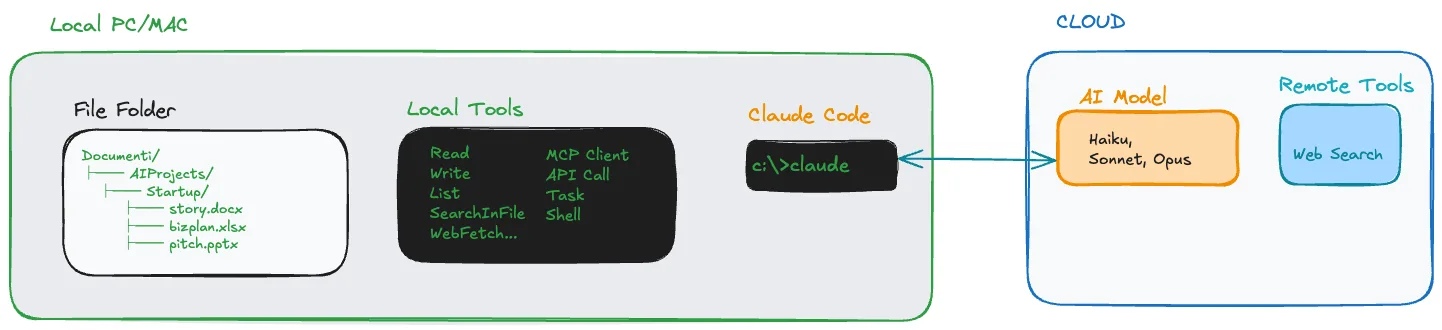
A workspace running Claude Code, with a CLAUDE.md that holds who you are and how you communicate.
A skill you build yourself, from scratch, and install: meeting minutes, or whatever you repeat most.
Two specialized agents splitting a real piece of your work between them.
Your first MCP connection, reaching past your own machine, with the safety rules that keep it in bounds.
Eight parts in order: each one leaves you something installed and working, and closes with a quiz to check what you took away.
Why a chat that forgets costs you time, and what changes when the AI keeps your context. You meet Giulia, a sales manager, and the work she does every week.
Describing the outcome you want instead of the next step. The approach that turns a conversation into a task you can hand over.
Claude Code, installed and open for the first time. The terminal, explained to someone who has never used one.
The same assistant inside Visual Studio Code, in a window with buttons instead of commands.
Real work to try it on: an email, a report, a file to go through. Small exercises, one after another.
Your own skill, built from scratch and installed. From here the assistant does what you taught it, by name.
Two agents, each with a job, working on the same task. How to split work that is too big for one.
The assistant connected to a folder or an outside service with MCP, and the boundary you set around it.
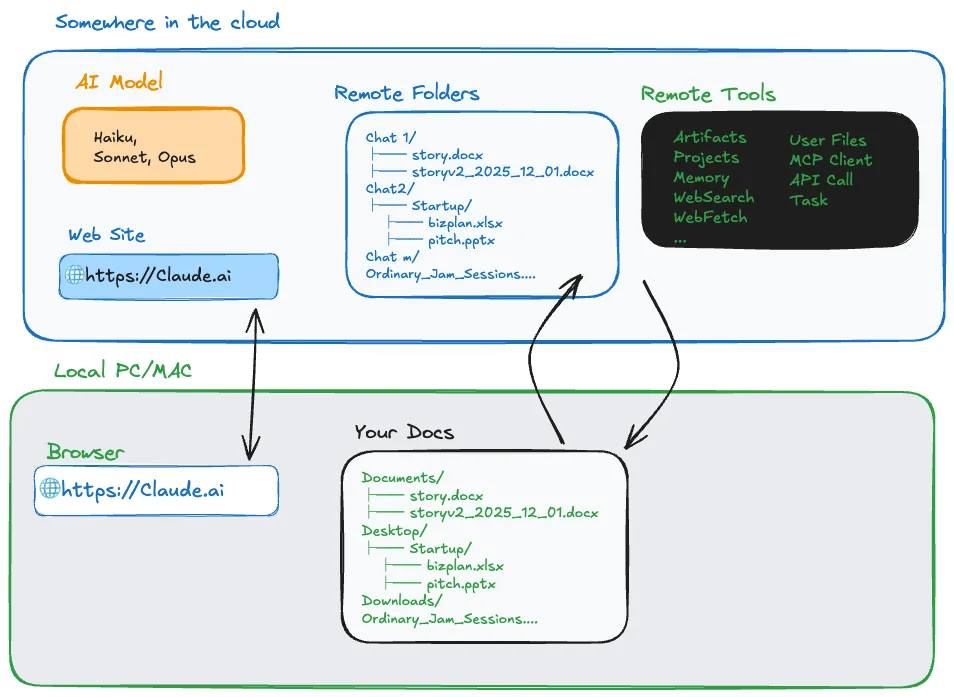
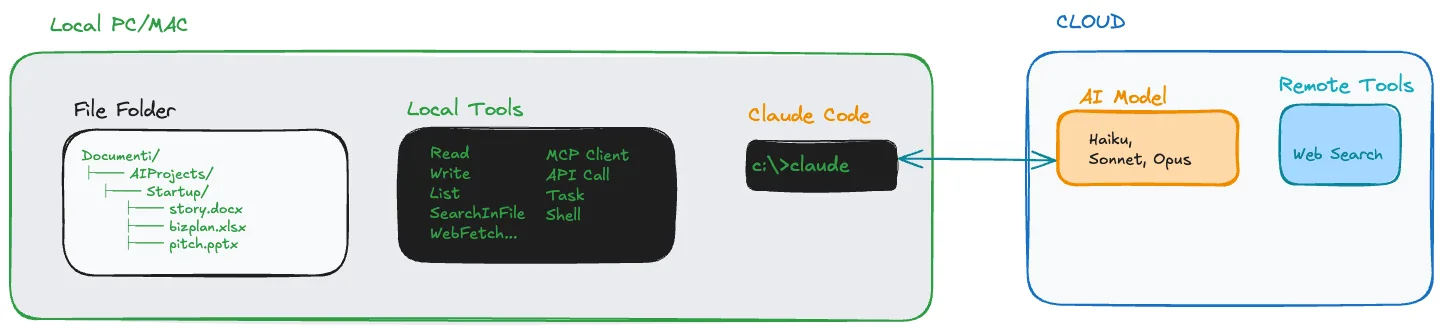
The two diagrams come from the course: they are the ones Part 2 uses to tell the two approaches apart.
Not notes: a file, a configuration, a skill that stays on your computer and works after you close the lesson.
Giulia, a sales manager, with her real workflows and the timings measured before and after: an email from five minutes to two, a report from fifty-two to two.
Stuck? Ask, in writing or out loud. It answers about the lesson you are on.
5 questions per lesson. At the end you get a course certificate, with the quizzes you passed.
You get good answers, but every conversation starts over and nothing you built stays.
Documents, spreadsheets, reports you redo every week. That is where an assistant earns its keep.
A Mac or a Windows machine you can install software on, a Claude subscription with Claude Code, and the basics of how generative AI works. Nothing else.
31 learning outcomes across 9 competences, in 5 of the 5 areas of the Joint Research Centre framework. You master 13, you consolidate 17, you are introduced to 1. For each one, the mapping says in which lesson and with which test.
For several people, team licences cost less per person.
If after 10 minutes you have not learned something new, you have lost 10 minutes.
No. You will use a terminal and an editor, but you write instructions in plain English. The course assumes you have never opened either.
Two hours of lessons. Around eight with the practice: installing, building a skill, connecting MCP.
Yes, on Mac and Windows both. Part 3 covers the setup for each.
You decide. The assistant runs on your machine and reads the folders you point it to, and Part 8 is where you draw that boundary.

Max Turazzini. 3 years of workshops in more than 200 companies, 2,000 people trained. I built this assistant for my own work first, and taught it in the rooms where people told me it would never work for them.
"You learn AI by doing it, by getting it wrong, and by having someone beside you who has been there before."
Start with the free lesson →