← All courses

Generative AI in Practice (beta)
Course · AI foundations · Level 1
How a generative AI actually works, explained while you try it. By the end you know when to trust an answer and when to check it.
Asking a model when it stopped learning becomes routine, and the answer tells you what to check.
A context template leaves the course with you, after you watch one question get two different answers with it and without it.
Hallucinations become recognizable, and so do the three areas where they happen most.
You make a bias come out of a neutral question, on your own screen.
Open them in any order. Every lesson ends with a quiz and with something to try in the AI you already use.
A model is trained, not programmed. What that takes: chips, energy, months. And why from one day on it stops learning.
One word at a time, each predicted from the last. The context you give decides which word arrives. The memory ends with the chat.
Hallucinations, bias in the data, guardrails and how people get around them, deepfakes. What always needs checking.
What it can do today with images, voice and video. Then how to start, one step at a time.
How much to write, what to put in it, and who the answer is for. The building blocks of a request. A vague prompt sends the work back to you.
An agent is the same model with infrastructure built around it. Give it a task, then watch the loop. A few terms, a few habits worth keeping.
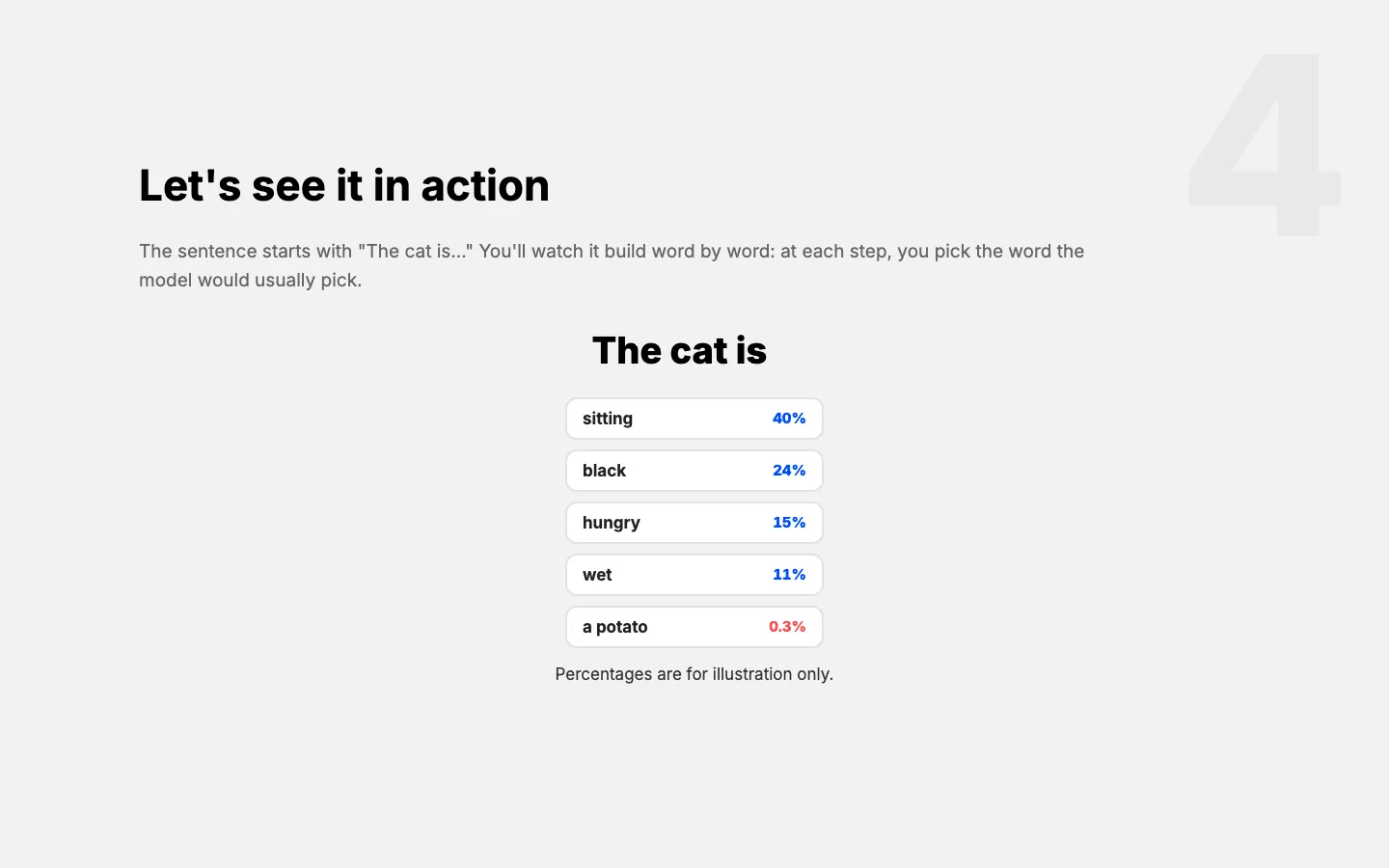
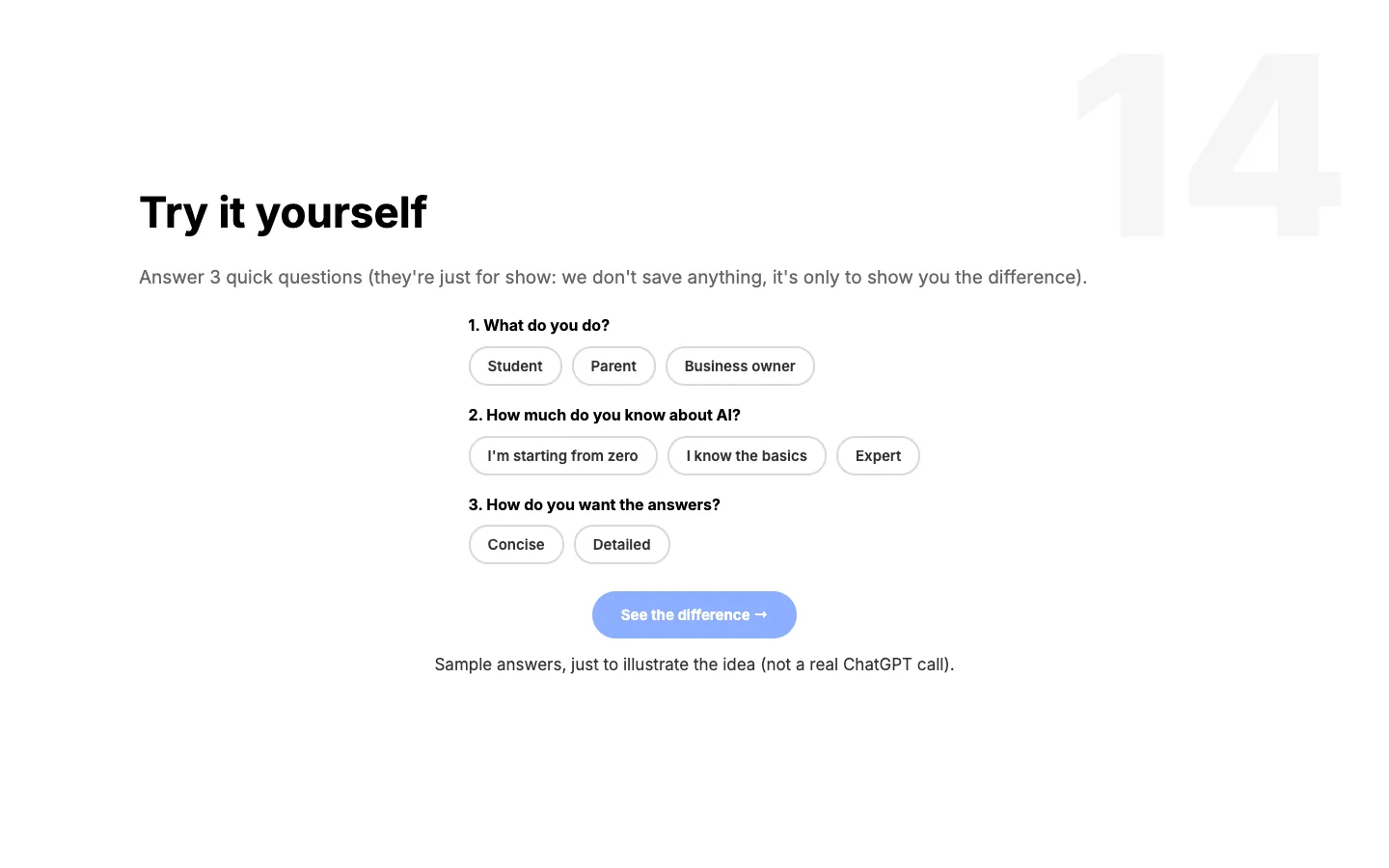
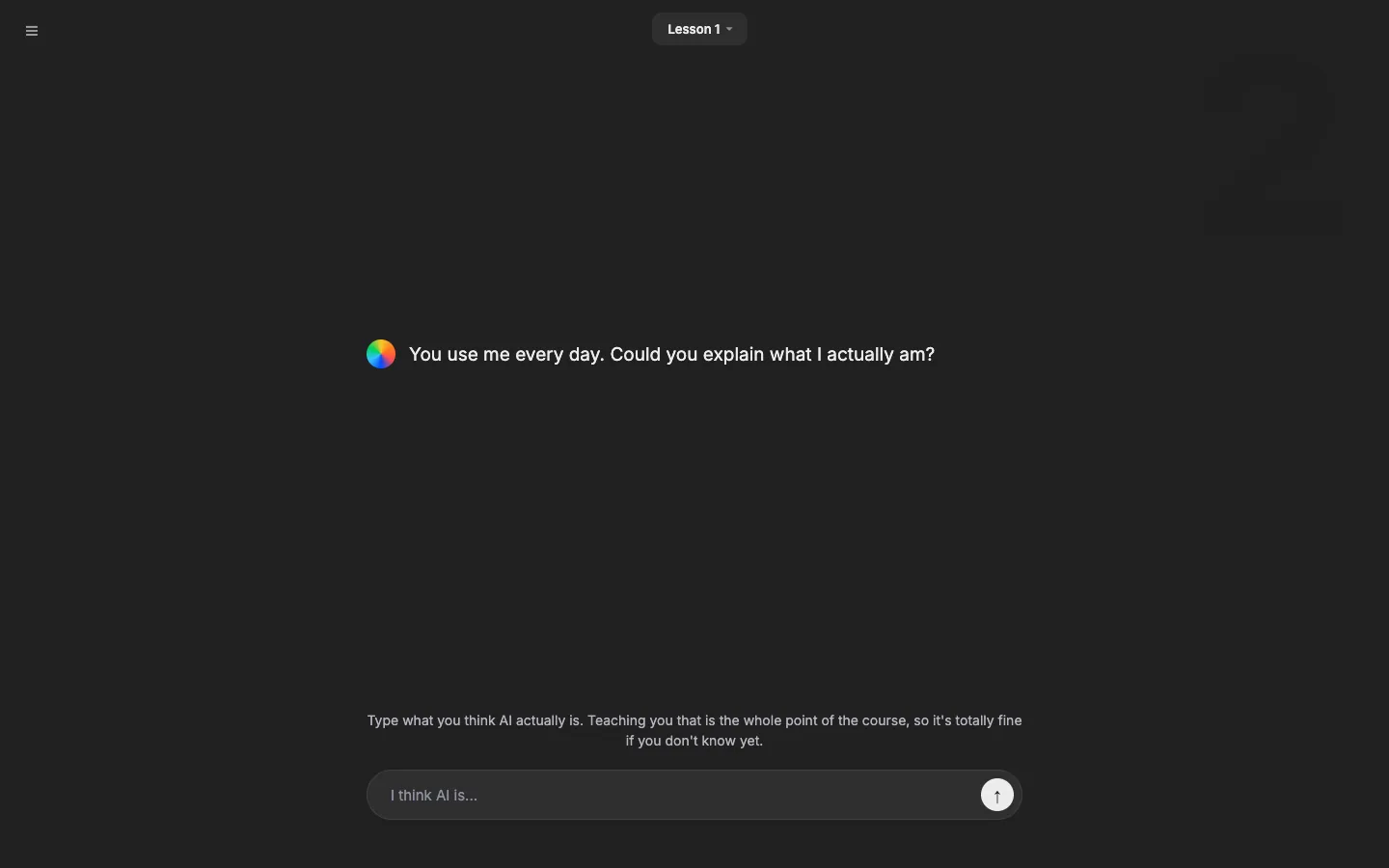
These are two real screens from the course.
The lessons are interactive: you touch, you drag, you find out. The explanation arrives once you have seen it happen.
Copy the prompt out of the lesson and run it in your own tool. A free account is enough.
Stuck? Ask, in writing or out loud. It answers about the lesson you are on.
7 questions per lesson, 10 in the fifth. At the end you get a course certificate, with the quizzes you passed.
Anyone who has to decide where AI goes and where it does not, and cannot decide it by instinct.
At home and at school it is already in use around you, and here is where it starts making sense.
No formulas, no code. Curiosity is enough. For the technical side there is Vibe Coding.
53 learning outcomes across 11 competences, in 5 of the 5 areas of the Joint Research Centre framework. You master 8, you consolidate 30, you are introduced to 15. For each one, the mapping says in which lesson and with which test.
"Introduced" means the topic opens here and another course closes it: what happens to company data that leaves the building is a course of its own.
The direct follow-up is AI-PLUG.
For several people, team licences cost less per person.
If after 20 minutes you have not learned something new, you have lost 20 minutes.
No. The exercises run on a free account of ChatGPT, Claude or Gemini. Whichever one you already use is fine.
The lessons take about two hours to read, three if you do every exercise, spread out however you like.
Yes, a course certificate: it states what you followed and completed, quizzes included. Keep it in your own records or in your company's.
Yes. It covers the "understand what it is and where it fails" part of AI literacy, which is what Article 4 asks an organization to support.

Max Turazzini. 3 years of workshops in more than 200 companies, 2,000 people trained. This course is the first hour of every workshop he runs, rebuilt so you can go through it on your own.
"You learn AI by doing it, by getting it wrong, and by having someone beside you who has been there before."
Start with the free lesson →